
Every queen needs a crown, right?

But when you put it on, it looks like an alien's toy?  

For an ant queen called Monomorium triviale, her crown is not the shiny kind.

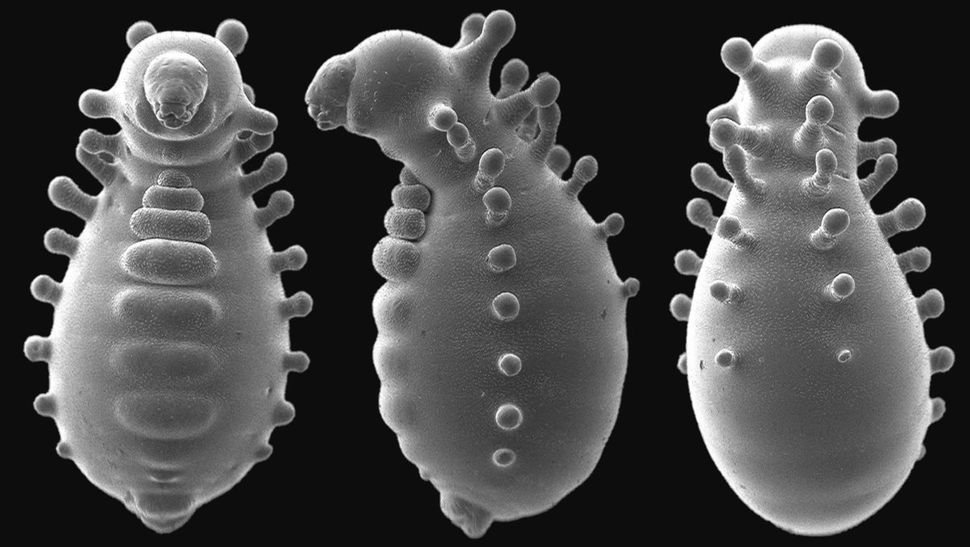
The queen ant of this type of ant, in its larval stage, will have many big bubbles coming out from its head, back and stomach. Interestingly, among this type of ants, only the larvae of the queen ant are so special, while the worker ants are very normal.

Maybe this way, the worker ant will know which larva is his future boss!  

Who is Monomorium triviale?

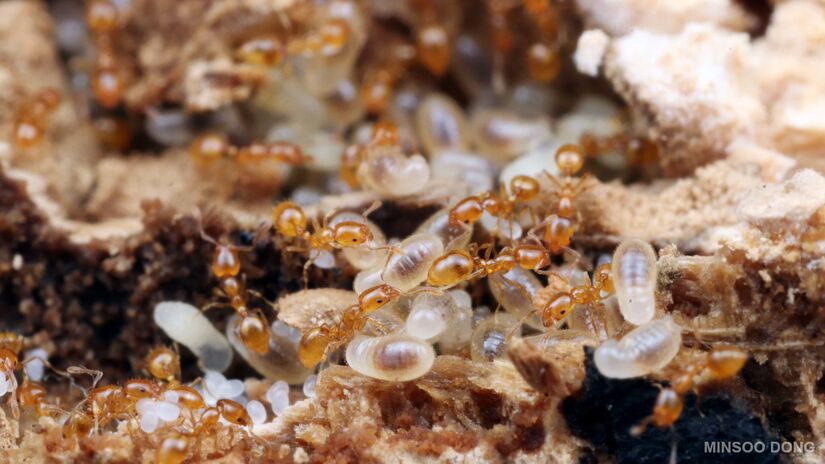
This amber-colored ant lives in China, Japan and South Korea and can be translated as "common single house ant".

825px Monomorium triviale Tsushima Island Japan Minsoo Dong
Photo Credits: Minsoo Dong

Interestingly, their queen ants do not need a male ant to produce worker ants, a process called parthenogenesis. In fact, a new study published on March 3 in the journal Zootaxa shows that no one has ever seen a male M. triviale ant; all the family members were born by the queen herself.  

Special appearance after ants

The last larva of this ant is really special.

Instead of having almost no hair on her body (most ant larvae have hair on their bodies), she grew 37 little balls that looked like doorknobs.

She looks like an alien plush toy, or like a squeeze toy from another universe.

jTexH79GChNEbHA9e7oAfE 970 80
Image source : ldowaga et al., doi:10.11646/ZOOTAXA.5105.2.5, CC BY 4.0

What are these little balls for?

Scientists have found that these blobs are made up of extended skin and epidermis that is twice as thick as the rest of the body. There are no muscles or other specialized parts inside these blobs.

So scientists are wondering: what are these little balls for?  

They are not sure yet, but there are some possible explanations.  

Perhaps these structures can help support the larva's body, make it easier for her to stick to the ceiling of the nest, or help her fend off attacks from other larvae.

These blobs may also be involved in feeding, and may be used to hold food in place, or to help pass food between larvae.  

Conclusion

It's an odd look, but M. triviale's queen ant larvae can handle it.

Now, scientists just need to figure out why. But whatever it is, it's a really cool look, isn't it? Let's look forward to more explorations of this strange ant world in the future!  

References

Larva ant queen looks like an alien doll in trippy new microscope imagesMonomorium triviale

How do you feel about this article?

Click to rate

average score 5 / 5. Statistical Results 7

No ratings yet—be the first to rate!

Thank you for liking this post!

Why don't you share it with a friend so he can see it too?

I'm sorry you didn't like the article.

Let's improve him together!

Where do you think it could have been written better?

發佈留言